Wine Cooler Repair · Downtown Edmonds
Why does a Sub-Zero wine zone drift off its setting?
One zone warm while the other holds is information, not a verdict. What the drift points to, checked in order: air, door, sensors, fans, sealed system.
By Marta Fennimore Refrigeration technician — ice systems and water supply · 12 years in the trade EPA Section 608 certified
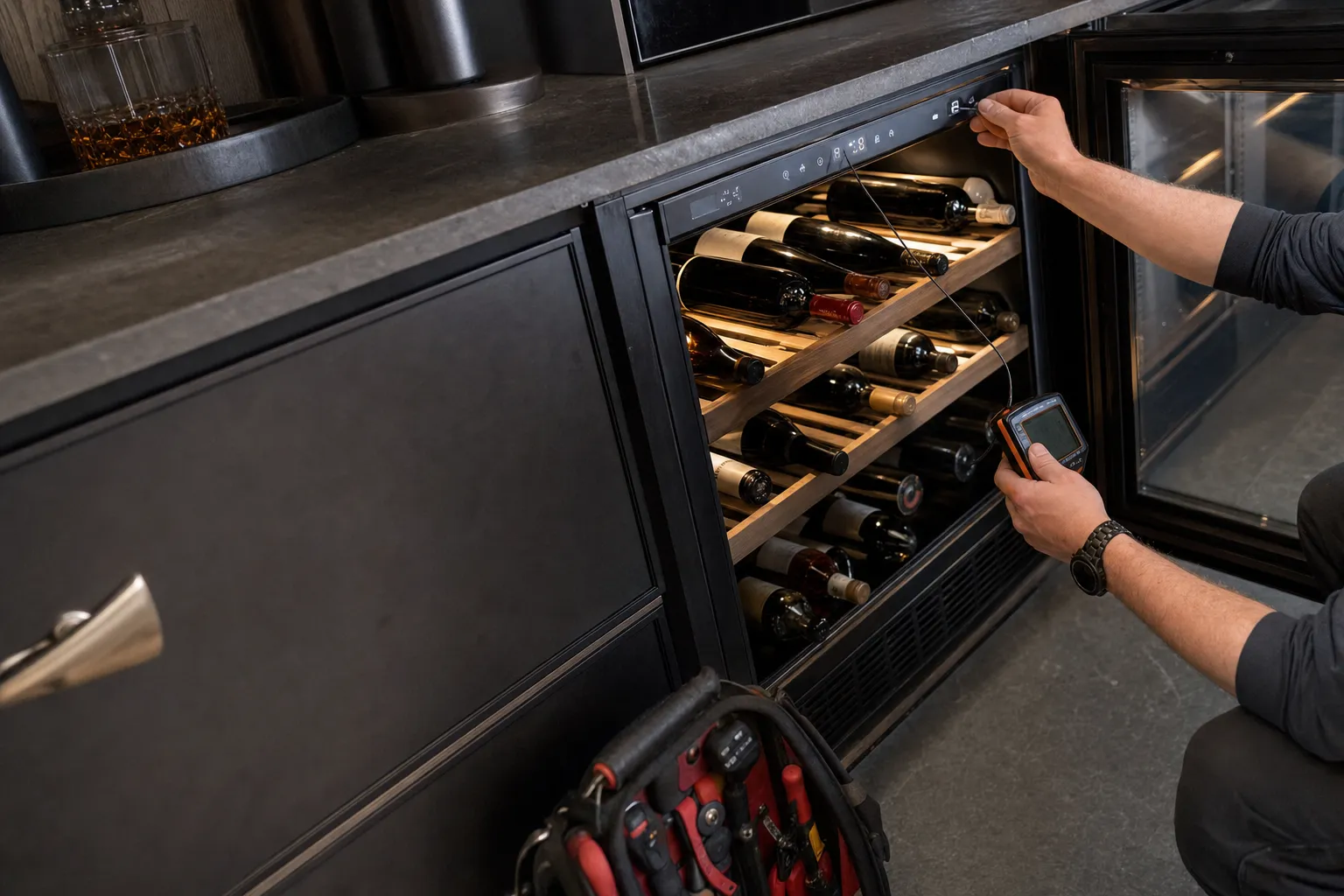
A dual-zone Sub-Zero wine unit that reads 52°F in one zone when it is set to 45°F, while the other zone sits exactly where it should, sounds like a machine on its way out. It does not have to be. Two zones that disagree are handing you a useful piece of information: whatever is wrong affects one of them more than the other, and that narrows the search.
What follows is roughly the order things get checked on a service call, cheapest first. Some of it you can do yourself.
What a split reading between zones tells you
How the cold is shared between the zones differs from one design to another, so the reading is the starting point, not a guess about the layout. Each zone is held to its own setting. When one drifts while the other holds, the first suspects are the things that serve that zone: the air reaching it, the seal along its stretch of door, any fan that moves its air and the sensor that reports its temperature.
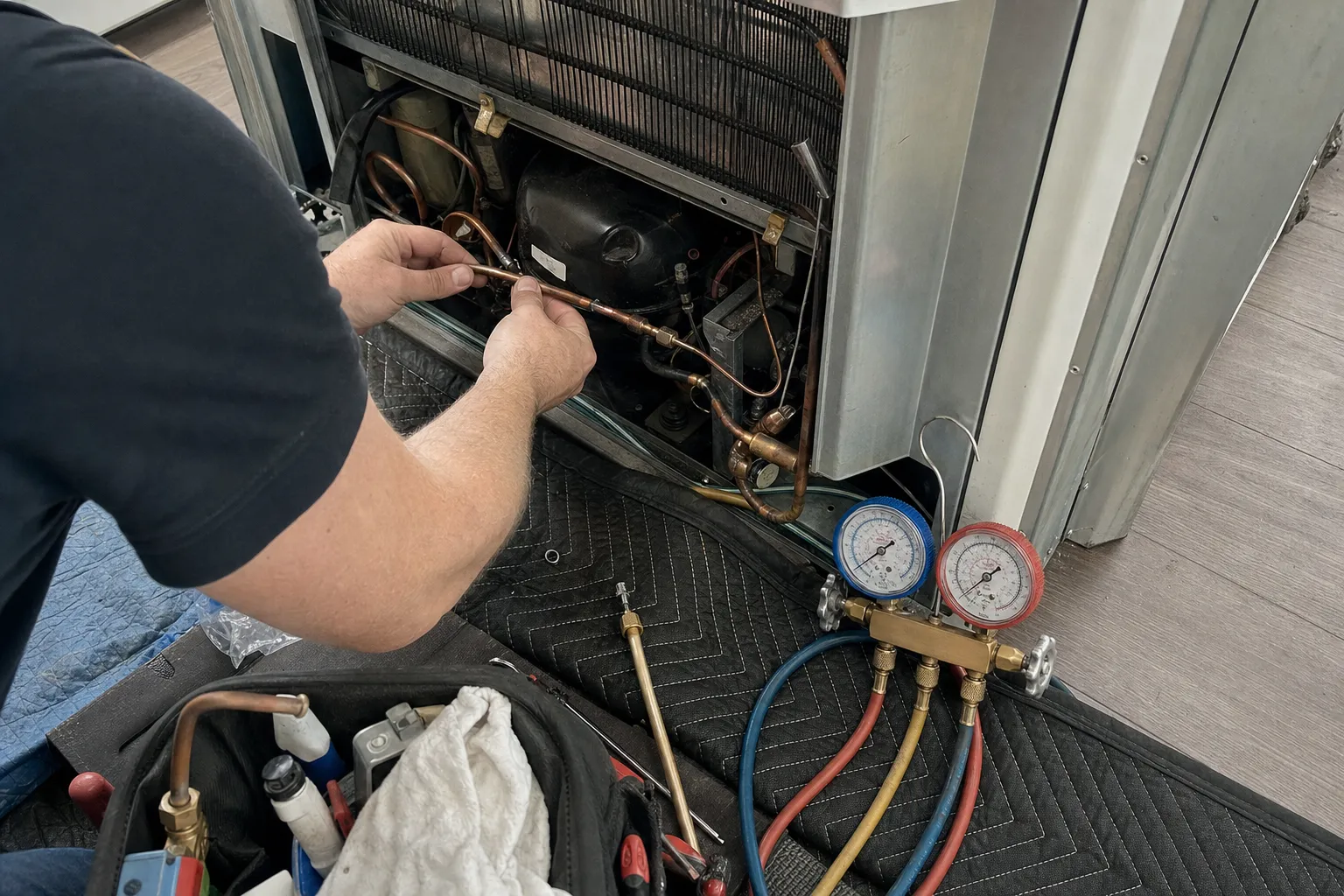
When both zones are warm, look instead at what serves the whole cabinet: the grille and the condenser behind it, the condenser fan, the room and the control. Only after those does the answer become the sealed system, and that is confirmed with gauges rather than assumed.
Airflow first: the condenser, the grille and the load
Before anything electrical gets tested, the air is checked. A wine unit that cannot get rid of its heat cannot hold temperature, however healthy its electronics are.
- The condenser coil. It comes first because it is the cheapest thing to check, and near the water it has more to contend with. Salt carried on the air off the Sound works at the thin metal of the coil, so a unit in the Bowl or along the bluff can slowly lose some of its ability to shed heat, running long and still falling behind.
- The grille and clearance. The unit breathes through its grille. Trim fitted flush during a remodel, or a basket parked against the front, quietly takes some of that air away.
- The load. Bottles packed solid against the back wall block the air moving inside the cabinet. Leave gaps.
Clear the grille, clean the coil the way the care guide for your model describes, and give it a full day before judging the result.
The door, the glass and the seal
The door comes next: a large sheet of glass held against the cabinet by a gasket around its edge.
Run a hand around the gasket with the door closed. A seal that has gone stiff and papery, or that has taken a set from years of compression, lets a slow bleed of warm room air into the cabinet, and warm air that gets in tends to show first near the top.
Water beading on the inside of the glass can mean room air is finding its way past the seal, so mention it when you call. Fog between the panes of a door with more than one pane is a different fault: the seal between the panes has gone, which is a door repair rather than a gasket.
Also check how the door closes. One that no longer closes square, which can happen after a unit has been moved for cabinet work, leaves a gap you can feel with a sheet of paper.
When it is a sensor, a fan or the control
If airflow and the door check out, the fault is electrical, and this is where guessing gets expensive if nobody is measuring.
A thermistor is a temperature sensor whose resistance changes predictably with temperature. When one misreads, the control is misled slightly rather than dramatically, and a zone settles a few degrees away from where it should. Testing means reading its resistance at a known temperature and comparing it with the published value for the model.
A failing fan serving the affected zone leaves a warm compartment even while the cold is being made: the cold simply is not moved. A fan that has grown louder than it used to be, most noticeable in a quiet house in the evening, is worth reporting before it stops.
The control board comes last, once the sensors, the fans and the air path have all been measured.
When it is worth calling someone out
Do the free things first: clear the grille, clean the coil as your care guide describes, check the seal, unpack the cabinet a little, and give it twenty-four hours.
Call if any of the following is true. The drift is three degrees or more and has not improved after a coil clean. Both zones are warm. The compressor is running without stopping. There is condensation between the panes of the glass. Or a warning has appeared on the display.
What you should not do is let it run warm for a season on the theory that it is holding “close enough”. A condenser starved of air is one of the recognised causes of compressor failure, and that is how a job that needed a brush and a vacuum turns into a sealed-system quote later on.
Common follow-ups
How far off is too far off for a wine cooler?
Judge it with a thermometer, not the display, which shows the setting. Sub-Zero's method for its refrigerators works here too: a thermometer in a cup of water mid-zone, read after 12 hours. A zone that stays several degrees off across a whole day with the door shut is worth a call to Sub-Zero Repair Edmonds, (206) 210-3547.
Is a wine unit that will not hold temperature a sealed-system failure?
Not until everything cheaper has been ruled out. The grille and condenser, the door seal, the fans and the sensors can each warm a zone on their own, so all of them are checked before any gauges go on. If the sealed system has failed after all, the repair is priced from its published range once the $89 diagnosis has confirmed it.
Can I clean the condenser myself?
Sub-Zero's care guides expect owners to, with the power off at the control, gloves on against the sharp fins, and a soft brush and vacuum worked along them; follow the guide for your model. What a technician adds is a close look at the fins for corrosion, which matters more near the Sound than it does inland.