Freezer Repair · Westgate
Reading the Frost: Why a Sub-Zero Freezer Ices Up
Where the frost forms tells you what failed: the four ice patterns in a built-in Sub-Zero freezer, what each means, and which you can settle yourself.
By Marta Fennimore Refrigeration technician — ice systems and water supply · 12 years in the trade EPA Section 608 certified
Frost in a built-in freezer is not one fault, it is four or five different faults that all happen to produce ice. The useful thing is that they do not produce ice in the same place. Before you defrost the cabinet and destroy the evidence, look carefully at where the ice actually is — that single observation eliminates most of the diagnostic tree.
What follows is how the patterns are read on a service call, and which of them are worth your own Saturday morning rather than a technician’s afternoon.
Soft frost on everything, evenly
A light, powdery coating over packaging, baskets and walls alike, with no obvious concentration anywhere, is a humidity problem. Warm moist room air is getting into the cabinet and depositing its moisture on the first cold surface it meets, which is everything.
The causes, in order of likelihood:
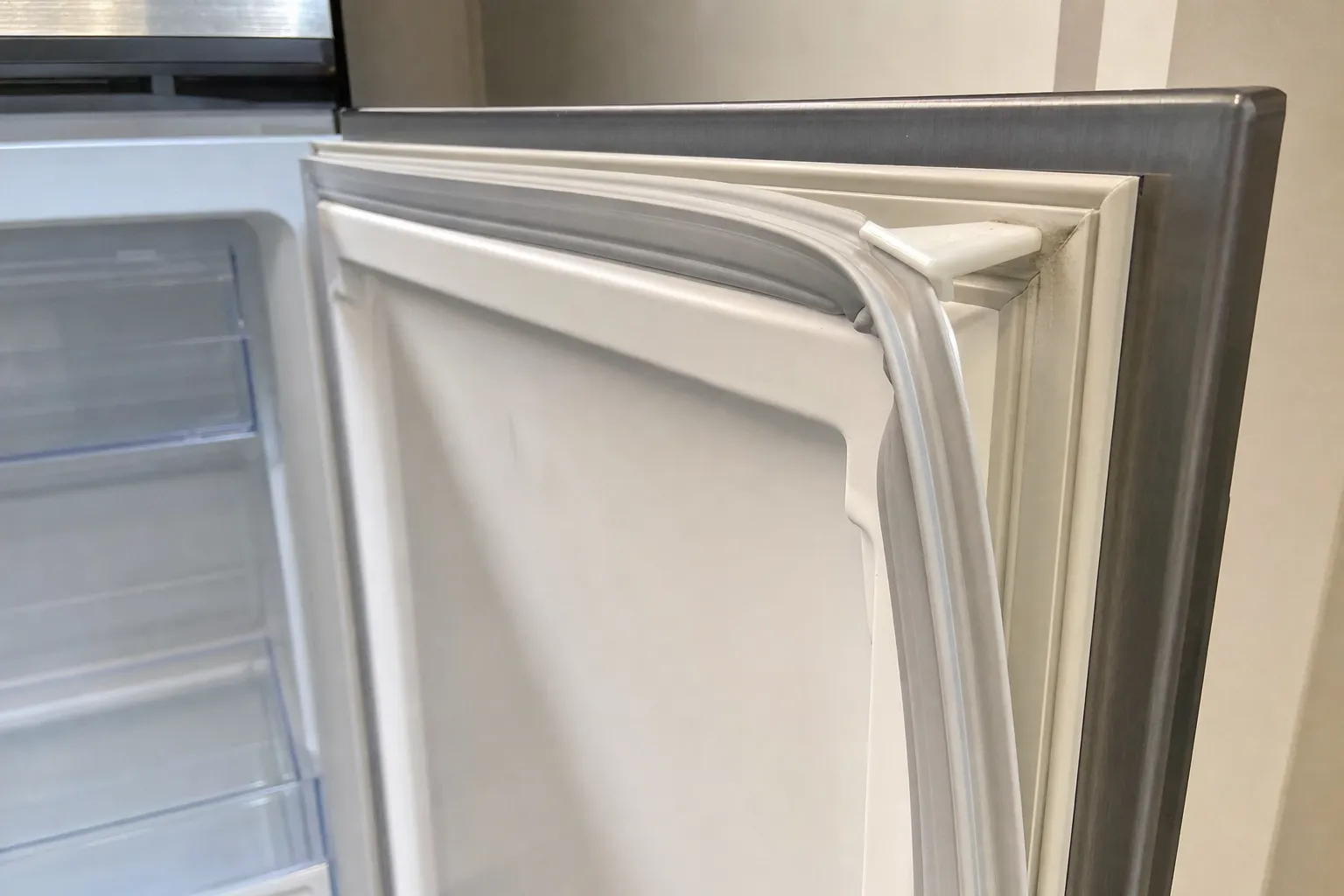
- A door that is not sealing. Run a hand along the gasket. If it feels stiff and papery rather than pliable, or if it has taken a permanent set where it compresses, it is bleeding air. On drawer freezers, check that the drawer closes flush across its whole width — a drawer that has dropped on its runners leaves a wedge-shaped gap at one end.
- A door left open. More common than anyone admits, especially with drawer models where a package can hold the drawer a quarter inch out without it being obvious. If the door alarm has been sounding, believe it.
- Genuine seasonal humidity. A damp Puget Sound autumn genuinely does load the cabinet more than a dry month. This produces more frost, not different frost, and it should still clear on the normal defrost cycle.
This category is the good news case. A gasket is a modest part, and fitting one is routine work.
A hard slab under the bottom basket
Clear, solid ice pooling at the floor of the cabinet — the kind you have to chip at — is a drain problem, not a sealing problem.
Every frost-free freezer melts its evaporator frost periodically and sends the water out through a small drain to a pan near the compressor. Restrict that drain and the melting still happens exactly on schedule — it is the leaving that stops. Water backs up out of the trough, settles at the floor of the cabinet, and the next cooling cycle turns the puddle solid. The defrost after that lays its own contribution on top of the first. Read the slab as a stack of cycles and it is obvious why chipping it out only ever buys weeks.
The restriction tends to be one of three things: debris in the drain opening, a failed drain heater on models fitted with one, or ice that has bridged the drain tube itself further down. Clearing the visible opening sometimes buys months. If the slab returns quickly, the blockage is deeper than the part you can reach and needs the panel off.
Left alone, a drain slab eventually reaches the door seal and forces the door out of alignment, at which point you have both problems at once.
Thick ice on the back wall behind the panel
If the rear inner panel is cold, sweating, or visibly bulging, the ice is on the evaporator coil itself and the defrost system has stopped working.
The healthy version of this system is straightforward: the coil frosts up in normal operation, and at intervals a heater warms it just enough to melt that frost away. When the heater, the defrost thermostat or the control that triggers the cycle fails, the coil keeps frosting and never clears. In time the fin spaces pack solid, and at that point the coil has stopped being a heat exchanger and become a block of insulation. The compressor runs on. The metal behind the panel is genuinely cold. The compartment in front of it still climbs, because nothing is getting through the fins to carry that cold anywhere.
This pattern can sit behind an “it runs all the time but it is not cold” complaint, and it is easy to mistake for a dying compressor, because the machine is audibly working hard and failing. When the coil is packed like this, the first suspect is a part in the defrost circuit, priced in the defrost band rather than the sealed-system one, and identifying which part takes meter readings rather than opinions.
The tell to look for: a freezer that is slushy at the top and still frozen at the bottom while the compressor barely rests. That indicates an evaporator that has iced past the point of useful airflow.
When the frost says the refrigerant is short
There is one frost pattern that points away from the defrost circuit and towards the sealed system, and it is the opposite of a packed coil. With the rear panel off, a technician sometimes finds the evaporator frosted only where the refrigerant enters it — the first few passes white, the rest of the coil nearly bare.
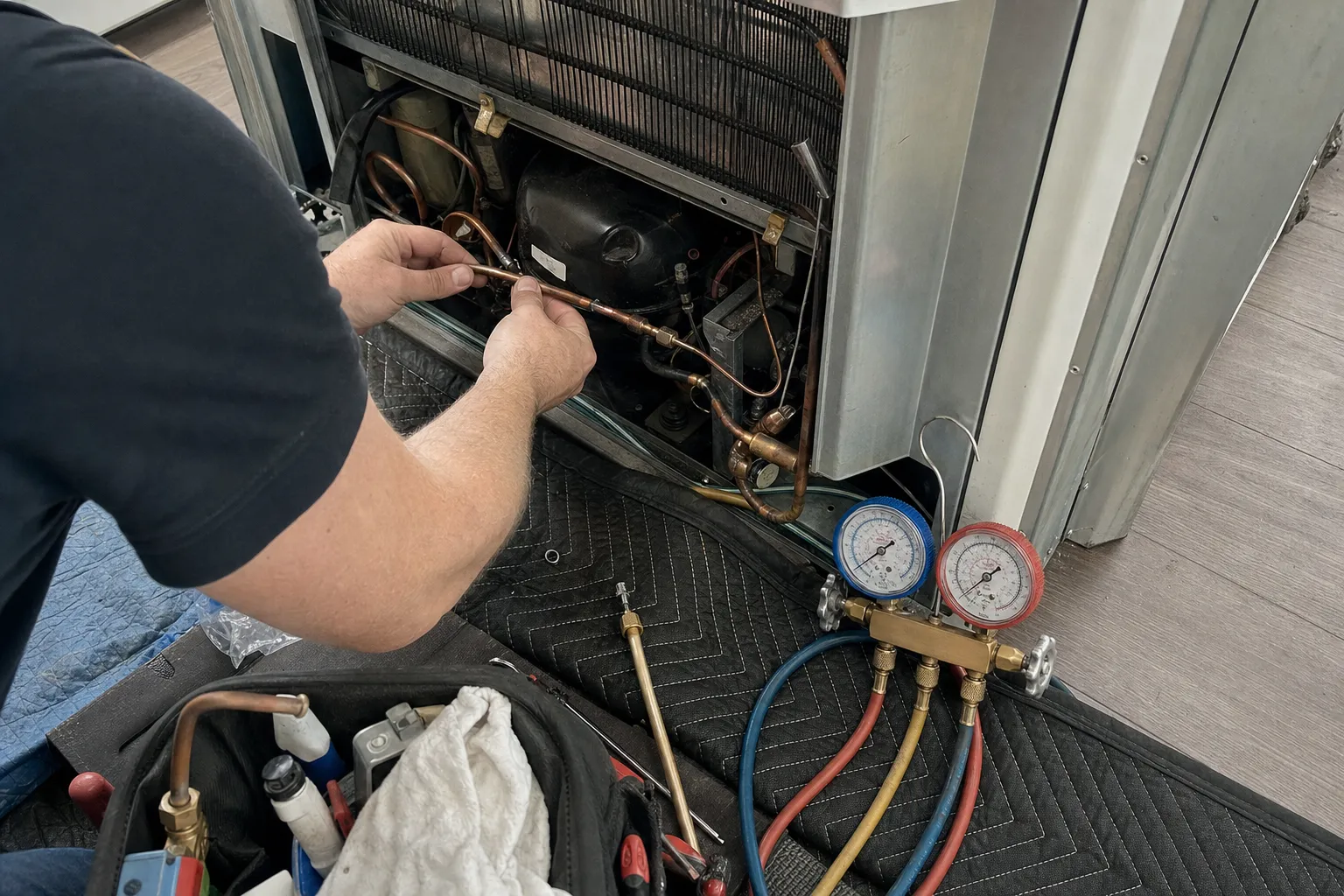
That is what too little refrigerant looks like. The charge that is left boils off in the first part of the coil and has nothing left to absorb heat with further along, so only a fraction of the coil is doing any work. A partial restriction in the line feeding the coil can starve it the same way, which is why the frost pattern starts the diagnosis rather than ending it: gauges tell a leak from a blockage.
You will not see this one from the front of the cabinet. What you notice instead is a freezer that loses a degree or two a week with no ice anywhere you can reach. Refrigerant does not get used up, so a short charge means it escaped somewhere, and topping it up without finding where only restarts the clock.
Frost only around the ice maker
Localised frost in the ice maker bay, with a clean cabinet elsewhere, points at water rather than air. Either the fill tube is misaligned and spraying past the mold, the inlet valve is weeping and dribbling continuously, or the ice maker’s own defrost is not clearing properly.
A weeping valve is worth catching early. It puts a slow, steady supply of water into a compartment designed to receive a measured amount at intervals, and the result is a frozen mass that eventually jams the harvest mechanism — which is how a small leaking valve becomes a seized module.
What to do before calling
Take a photograph of the ice before you touch it. Then defrost the cabinet properly: everything out, doors open until the last of the ice has gone, towels down. Do not attack the ice with a screwdriver — punctured evaporator tubing turns a repairable fault into a sealed-system job, and that is the most expensive mistake available in this whole article.
Once it is running again, mark the date. If frost returns to the same location within two to three weeks, you have a live fault and the pattern you photographed tells whoever comes out where to start.
Call sooner rather than later if the rear panel is iced, if the compartment is still well short of 0°F the day after a full defrost, or if the unit has begun short-cycling — running briefly, clicking off, restarting a few minutes later. That last one is a machine under strain, and it does not improve on its own.
Common follow-ups
How much frost can a Sub-Zero freezer carry before it is a fault?
A thin powder on packets after a weekend of the drawer opening and shutting is fine; the automatic defrost clears it. Ice that lasts a week, comes back to one spot after you remove it, or sets as hard clear ice is a fault worth a visit from Sub-Zero Repair Edmonds, (206) 210-3547.
Does defrosting the whole unit fix it?
It resets the symptom, not the cause. A manual defrost is genuinely useful as a diagnostic — if the ice comes back within two or three weeks in the same place, you have confirmed an active fault rather than a one-off door left ajar.
How long should a Sub-Zero freezer take to get cold again after a defrost?
Hours, not minutes: an empty cabinet pulls down from room temperature faster than a loaded one, and every door opening sets it back. If it is still well above 0°F the next day with the door kept shut, the defrost was not the whole story and it needs a proper diagnosis.