Repair or replace
Corroded by Salt Air: Repair or Start Over?
- Signed
- Dean Halvorsen
- Role
- Refrigeration technician — sealed systems and airflow
- Certification
- EPA Section 608 certified
- Published
Straight answer
Repair, if the damage ends at the condenser (the finned coil that passes the unit's heat to the kitchen air). A leaking condenser is replaced as sealed-system work and the cabinet carries on. Start over when rust has spread into the frame, the hinges and tubing elsewhere. Sub-Zero Repair Edmonds can tell which you have: (206) 210-3547.
To replace it
$12,110–$21,200
a like-for-like new built-in, with the fitting and any cabinet work still to pay on top
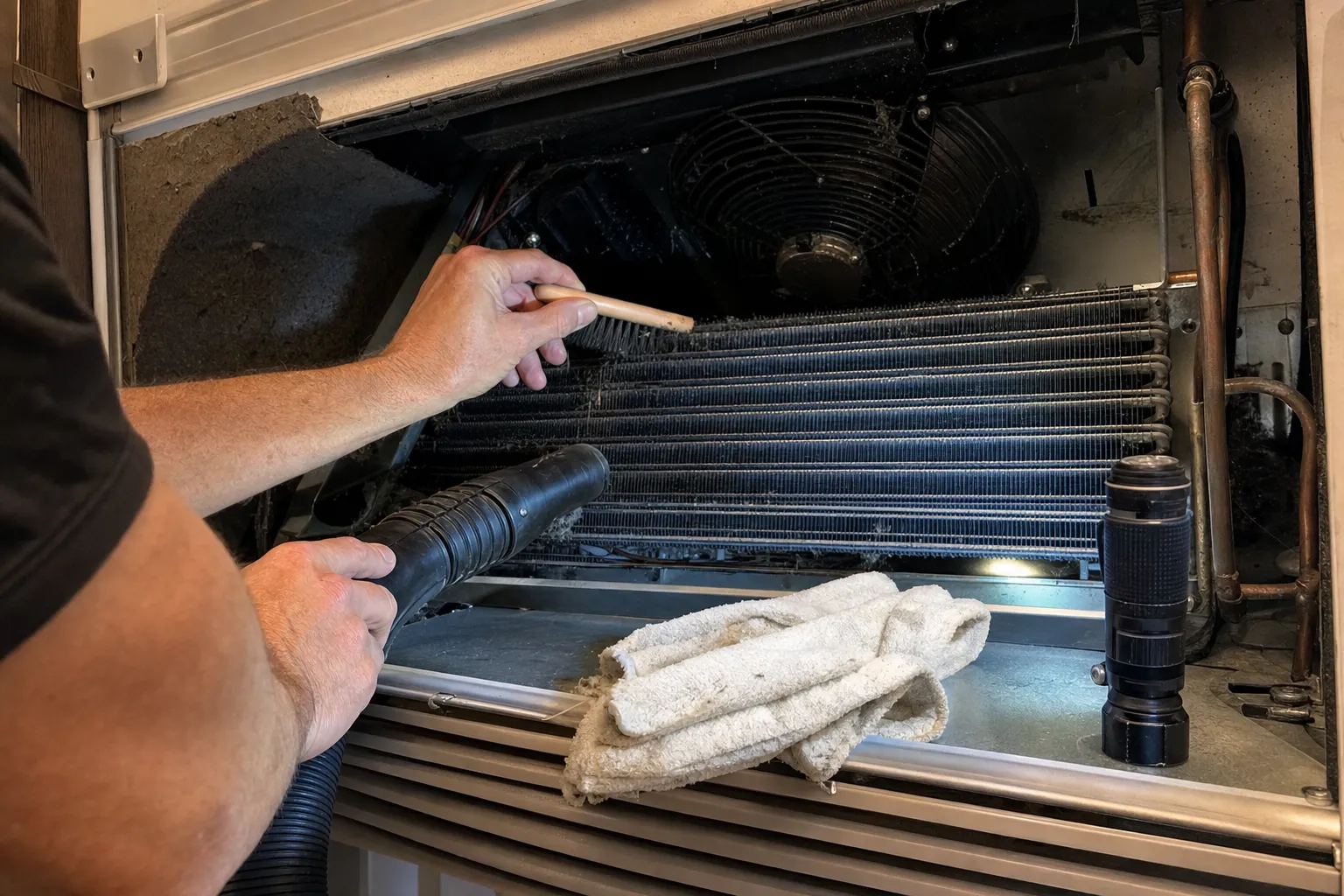
What salt air does to a coil
Sea air carries chlorides, and chlorides break down the oxide layer that normally protects copper and aluminium. With that film gone, moisture works on the bare metal. Two things follow. The pitted surface passes heat less readily, so the unit runs longer to hold the same temperature. Later, some of those pits go all the way through and become pinholes that let refrigerant out.
The condenser is where it tends to show, because it is the most exposed part: its fan pulls kitchen air across the fins every time the compressor runs. The evaporator (the cold coil inside the cabinet) breathes the air behind the doors instead.
Why a new unit does not cure it
A new refrigerator in the same kitchen breathes the same air. Replacing trades a corroded condenser for a clean one that starts the same process on day one, so the salt on its own is not a reason to buy.
What decides it is how far the damage has travelled. The condenser is a single piece of the sealed system (the refrigerant’s own circuit: compressor, coils, drier and the tubing between them), and a coil lost to salt can be cut out and replaced without touching the cabinet around it. A frame, hinges and tubing corroded throughout are a different matter: at that point the repair would be one of several.
Keeping the next coil longer
Keep the grille clear and the coil free of dust, and never spray anything acidic on it, since acids attack the same metal the salt does. How often and how to clean it is a job for the manufacturer’s care guide; the point here is only that salt left sitting on the fins has longer to work.
Repair makes sense when
- Corrosion shows on the condenser and the lines beside it, while the liner, doors and frame are clean.
- The only leak traced is in the condenser, so a single coil, a new drier and a fresh charge close the system again.
- The unit sits in a niche or behind joinery that a different model would not slot into.
Replace it when
- Rust has moved on to the cabinet frame, the hinges or the door hardware: the box is going, not just the coil.
- Leaks keep turning up at points along the tubing well away from the condenser.
- A condenser already changed for corrosion has started to leak again.
What we check first
- Where the corrosion actually is: condenser fins and tubes, the joints by the compressor, then the frame and hinges.
- Whether refrigerant is escaping at all, found by a leak search before anyone quotes a coil.
- How much of the lost cooling is plain dust packed into the coil rather than metal eaten away.
Questions people ask next
Does living near the Sound mean my Sub-Zero will corrode?
Not necessarily. Salt in the air is only one source of chlorides, the compounds that strip the thin protective film from copper and aluminium; household cleaners are another. A unit in a kitchen near the water is simply worth a look at the condenser once cooling starts to slip. Sub-Zero Repair Edmonds does that on (206) 210-3547.
Would cleaning the coil be enough, rather than replacing it?
Cleaning lifts off dust and loose deposits, and that alone can win back some cooling. It cannot put metal back. Fins that have pitted stay pitted, and a coil with a pinhole has to be replaced, because the condenser belongs to the sealed system and the refrigerant charge must be restored once it is opened.